
Can You Remove Rock with Tannerite? Here’s the Real Deal

If you’ve ever stared down an immovable boulder and wondered if there’s a faster, louder way to handle rock excavation, you’re not alone. Blowing it up can feel like the ultimate DIY move. So, can you remove rock with Tannerite?
You’ve probably seen a video of some guy with a rifle and a bunch of binary explosives making stuff blow up in a cloud of dust and smoke. It looks fun, and on screen, it kind of is. But on a real job site, with real equipment and liability? That’s a different story.
Let’s break down what really happens when you use Tannerite for rock excavation, what works, what doesn’t, and why RockZone Americas offers safer, smarter tools to get the job done right.
Key Takeaways
- Blowing up rock with Tannerite might look exciting, but it’s risky, unpredictable, and not built for real excavation work.
- RockZone Americas attachments give you precise, safe, and efficient ways to cut, crush, and remove rock without the hazards of explosives.
- When the job calls for power and control, skip the blast and trust proven tools designed for professional results.
What is Tannerite and How Does It Work?
Tannerite is a binary explosive, made by mixing a fuel like aluminum powder with an oxidizer such as ammonium nitrate. On its own, it’s stable. Once mixed, it becomes explosive and can be detonated by a bullet traveling over 2,000 feet per second, usually from a high-powered rifle.
It’s designed for recreational target shooting, not for rock excavation, stump removal, or demolition. Unlike dynamite or other commercial explosives, Tannerite has a low detonation velocity and lacks the force to break or displace dense material like rock.
You’ve probably seen a video of a guy setting off a Tannerite blast that throws debris into the air, but those results are unpredictable and dangerous. Tannerite isn’t meant to be buried, stuck to objects, or used for structural removal. Using it that way isn’t just risky—it's a mistake.
Is Tannerite Actually Effective for Rock Removal?
So, can you remove rock with Tannerite? Technically… yes. A strong enough blast might crack a boulder, especially if the rock is already fractured or shallow. But “might” is doing a lot of work here.
The explosive force from Tannerite is limited compared to professional tools or commercial explosives like dynamite or nitro. It simply doesn’t have the velocity or material-cutting power to consistently break solid rock.
Using Tannerite for rock removal is kind of like using a firecracker to fix a plumbing problem. Here's what you’re really in for:
- Unpredictable results: You can’t determine how or where the rock will split. The blast might shift the material, or it might do nothing at all.
- Shallow impact: Most of the energy escapes into the air instead of penetrating the rock, especially if the surface is dense or the charge isn’t placed perfectly.
- No cleanup advantage: You’ll still need to move the fractured debris, and now it's scattered and possibly sharp or unstable.
- One-shot deal: If the first attempt fails, you’ve got a partially fractured boulder, a smoky hole in the dirt, and no easy way to try again.
People sometimes assume it’s a quick fix, but the results can be wildly inconsistent. And using more Tannerite to compensate can push things from questionable to downright dangerous.
Why It’s Risky and Sometimes Illegal
Here’s what flashy videos often leave out: the real risk.
Tannerite is stable before mixing, but once detonated, it becomes a powerful force that’s hard to control. There have been cases where a single blast sent rock chunks into a house, broke a camera, or caused serious injury.
One common mistake is placing Tannerite too close to solid objects. In stump removal or amateur rock excavation, this can send high-speed debris toward nearby people or structures. Some users have been hurt simply by standing too close when it is triggered.
Key safety concerns include:
- Shrapnel danger: Blasting rock can launch sharp fragments in unpredictable directions. These can strike someone’s head, mouth, or damage nearby equipment.
- Fire risk: While Tannerite isn’t flammable, the explosion can ignite dry grass, trees, or a dead log nearby.
- Noise complaints: The sound resembles dynamite and carries far. It often leads to police being called to the site.
- Legal issues: Once mixed, Tannerite becomes a regulated explosive. It is often banned on public or federal land, and transporting it without a permit is illegal.
In the end, it might look fun, but the risk, damage, and legal trouble just aren’t worth it. Safer, more effective tools exist for the job.
Why We Don’t Recommend Tannerite for Rock Removal
At RockZone Americas, we believe in using the right tool for the job, not just whatever creates the biggest blast. While Tannerite might look like fun in a video, it is not a practical solution for serious rock excavation or digging projects.
Here’s why Tannerite should stay at the range:
- No accuracy: You cannot control how the rock will break. A poorly placed blast can damage nearby utilities or structures and may send sharp debris toward someone’s head or camera.
- High risk: Even a small amount of Tannerite can start a fire, cause someone to get hurt, or worsen already blocked or narrow workspaces.
- Low efficiency: Blowing up rock still leaves you with jagged, heavy fragments to remove. It adds to the workload instead of reducing it.
- Restricted use: On most job sites, using explosives like Tannerite requires special permits and inspections. Without proper authorization, the legal consequences can be serious.
- Environmental impact: A single blast can disturb soil, nearby trees, and surrounding habitats. Dust and vibration can create issues, especially near residential areas, and may lead to complaints or visits from the police.
Using Tannerite for rock removal is unsafe, inefficient, and often unnecessary. Purpose-built tools offer better control, better results, and a much higher level of safety.
Smarter, Safer Alternatives to Tannerite
If your goal is to break rock, remove boulders, or trench through dense material, you don’t need to rely on unstable explosives. At RockZone Americas, we provide powerful, precision-engineered attachments designed for safe, efficient excavation, trenching, and demolition.
Our tools eliminate the unpredictability of blasting while improving control, safety, and productivity on site.
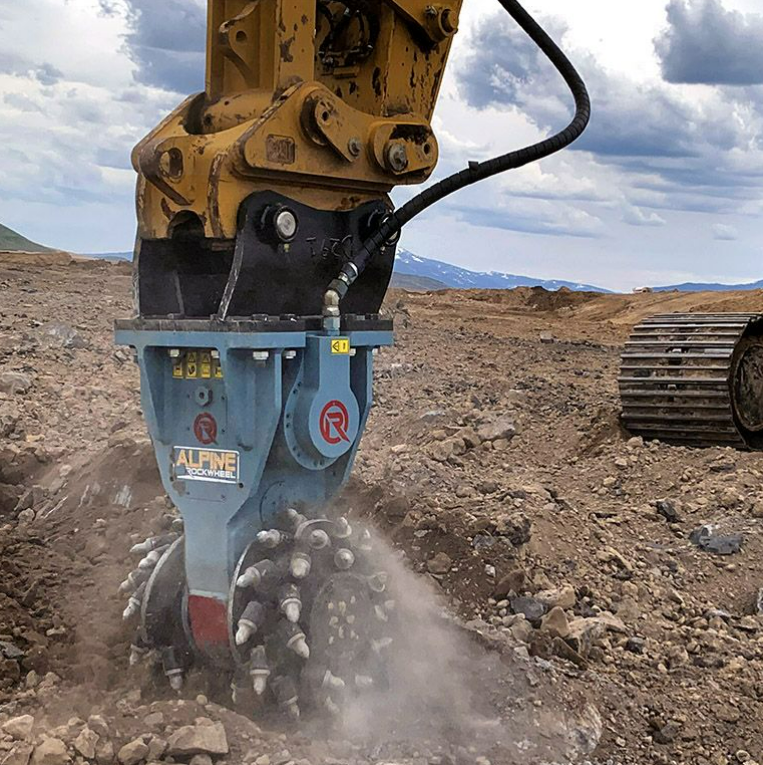
Rockwheels: Precision rock and concrete cutters
Rockwheels are built for high-performance cutting with low noise and vibration. They’re ideal for tight access areas, trenching, demolition, and applications where surrounding structures or terrain must be preserved.
Use Rockwheels for:
- Rock excavation and trenching
- Utility and pipeline work
- Demolition of reinforced concrete
- Vertical cutting and underwater excavation
- Stump grinding and slope work
Multiple models are available to match your excavator and material type, delivering accurate, controlled results even in mixed ground or frozen dirt.
Rockcrushers: On-site crushing attachments
Turn demolition waste and large rocks into usable material with our Rockcrushers. These attachments process concrete, stone, and rubble right at the job site, reducing disposal needs and material costs.
Ideal for:
- Demolition and land clearing
- Converting debris into backfill
- High-output crushing with consistent results
- Reducing transport and material handling time
Built tough and easy to maintain, Rockcrushers help you manage debris more effectively and keep the job moving.
Cutter buckets: Cut and scoop in one pass
Cutter Buckets combine cutting and excavation into a single attachment. Designed for areas with both soft and hard ground, they allow you to remove just what you need—no over-digging, no extra passes.
Great for:
- Trenching in layered or mixed conditions
- Slope shaping and soil mixing
- Reducing total excavation volume
- Jobs where drilling, grinding, and digging overlap
These tools save time, reduce equipment swaps, and keep operations efficient, even in blocked or difficult-to-reach locations.
Why RockZone Americas?
Blasting rock with unstable explosives creates more problems than it solves. It slows down your schedule, increases risk, and leaves behind a mess that still needs to be cleared. When accuracy, speed, and safety are non-negotiable, you need tools that perform without the uncertainty.
At RockZone Americas, we deliver excavation and demolition attachments that are purpose-built for real-world job sites. From cutting rock and trenching through dense material to crushing debris and handling mixed ground conditions, our tools are engineered for productivity and control.
We support excavation professionals working in construction, mining, tunneling, and infrastructure development. Our attachments are built to handle complex environments while reducing noise, vibration, and material waste.
With rental and purchase options, expert advice, and a U.S.-based support team, we help you get the job done efficiently. Call RockZone Americas to speak with a team that understands your challenges and knows how to solve them.
Conclusion
Yes, you can remove rock with Tannerite, but that often means dealing with risk, debris, and the potential for someone to get hurt. What looks like fun from a distance can quickly turn dangerous when explosives are involved.
Firing at a box of mixed materials with a detonator might blow a hole, but it can also damage a nearby house, start a fire, or send debris flying at someone’s head. Picking up random gear from eBay or copying what someone else tried isn’t worth the fallout.
RockZone Americas offers tools that do the work without the chaos. No guessing, no blasting, no cleanup surprises. Just accurate cutting, grinding, and crushing designed for tough jobs and real results.
Frequently Asked Questions
What is the easiest way to break a rock?
For most jobs, the easiest, safest option is mechanical cutting or grinding with attachments like drum cutters or cutter buckets. These give predictable results, produce manageable debris, and avoid the risks of using explosives or improvised blasters.
What do they use to blast rock?
Licensed blasting crews use commercial explosives, primers, and detonators under strict controls. Where blasting is unsuitable, contractors use hydraulic breakers, rotary drum cutters, chemical splitters, or crusher buckets to get the same result without the blast sounds and hazards.
How to get rid of big rocks?
If it can be lifted, use an excavator or skid steer with proper rigging. If not, cut or grind it into pieces with a Rockwheel or cutter bucket, or crush it on site with a crusher bucket to create reusable backfill and avoid hauling large debris.